Cash routes · Orange, Seminole & Osceola counties
Bitcoin ATMs in Orlando: The Honest Guide
Orlando has one of the densest crypto kiosk networks in the southeast — roughly 140 machines inside the city, run by around 18 operators. This page maps who runs them, what they really cost, what ID you will need, and when a kiosk is genuinely your best option rather than an expensive reflex.
Typically 3%–4% on a card versus 10%–23% at a kiosk
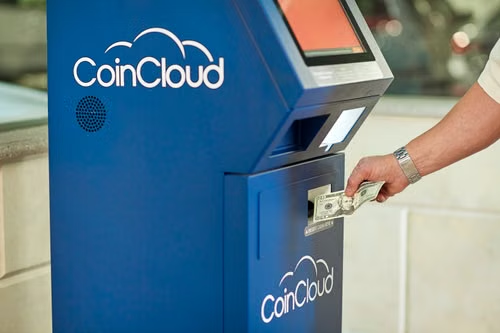
A Bitcoin ATM is not really an ATM. It is a vending machine that sells you cryptocurrency at a price the operator sets, and the gap between that price and the market price is how the business makes money. Once you understand that sentence, everything else about the Orlando kiosk scene makes sense — including why there are so many of them in gas stations and so few in bank lobbies.
We are not going to tell you never to use one. There are situations where a kiosk is the correct tool: you have cash, no bank account, and you need crypto today. That describes a real slice of Orlando's workforce, particularly in hospitality along International Drive. But you should walk up to the machine knowing the price of that convenience.
Who operates Orlando's kiosks
The market splits into three tiers. At the top sit two national operators with real compliance departments, published fee ranges and support lines you can call. In the middle are regional players running a handful of machines each. At the bottom is a long tail of small operators whose machines appear and disappear as host-store agreements come and go — these are the ones with the least predictable pricing and the thinnest support.
| Operator | Orlando footprint | Coins | Two-way? | Published fee | Site |
|---|---|---|---|---|---|
| Bitcoin Depot | ~29 machines, widest coverage | BTC, ETH, LTC | Rarely | Markup + network fee | bitcoindepot.com |
| CoinFlip | ~17 machines incl. Florida Mall, I-Drive | BTC + ~15 others | At many sites | 4.99%–21.9% + $2.49–$2.99 | coinflip.tech |
| Coinme | Retail cash-in rather than kiosks | BTC + select | Limited | Usually below kiosk rates | coinme.com |
| Athena Bitcoin | Scattered Central Florida presence | BTC mainly | Some | High single to low double digits | athenabitcoin.com |
| Regional & independent | Remainder of the ~140 total | Varies | Uncommon | Least predictable | Check machine screen |
What the fees really are
Kiosk pricing has two components and only one of them is obvious. The visible part is a percentage fee shown on screen. The less visible part is the exchange rate itself, which is quoted with a markup baked in. Add them together and you get the effective cost, which is the only number that matters.
Here is the arithmetic on a $500 purchase across the routes an Orlando buyer can realistically pick. We have used mid-range assumptions; your machine may be better or worse.
| Route | Effective cost | Fees paid | Crypto received |
|---|---|---|---|
| Exchange, ACH funded | ~0.5% | $2.50 | $497.50 of BTC |
| Exchange, debit card | ~3% | $15 | $485 of BTC |
| Retail cash-in network | ~6% | $30 | $470 of BTC |
| Kiosk, mid-range markup | ~14% | $70 | $430 of BTC |
| Kiosk, tourist-corridor pricing | ~21% | $105 | $395 of BTC |
The bottom row is not hypothetical. Machines in high-footfall tourist areas price for a customer who is not comparison shopping, and the International Drive and Lake Buena Vista corridors are exactly that market. If you live here, driving four miles inland to a residential-corridor machine can save you a meaningful amount on the same purchase.
Start the transaction on the screen before you commit anything. Most machines will show you the quoted rate and the fee at that point. Pull up the live BTC price on your phone, compare, and walk away if the gap is worse than you expected. There is no penalty for abandoning a transaction, and operators know their pricing varies — the machine two blocks away may be from a different company entirely.
Where Orlando's machines cluster
Placement follows cash. That is the whole logic. Operators pay host stores a share of revenue, so they target retail with heavy walk-in cash traffic: gas stations, neighbourhood groceries, check-cashing storefronts, smoke and vape shops, phone-repair counters, and a handful of mall locations.
In practice the metro has four distinct clusters. The Colonial Drive corridor (State Road 50) is the densest, running from Parramore east through Azalea Park to Union Park — you can pass eight or nine machines in a fifteen-minute drive. South Orange Blossom Trail is second, with strong coverage all the way to the Florida Mall, where CoinFlip has a machine at 8001 S Orange Blossom Trail. The tourist corridor along International Drive and toward Lake Buena Vista is third and generally the most expensive. And Osceola County along US-192 functions as a separate cluster serving Kissimmee's large cash-economy workforce.
Conversely, downtown Orlando, Thornton Park, Winter Park, Maitland and College Park are thin. The residents there are banked, use apps, and would not use a kiosk if one existed. Our neighborhood guide goes through each area with notes on hours, parking and safety.
ID, limits and verification tiers
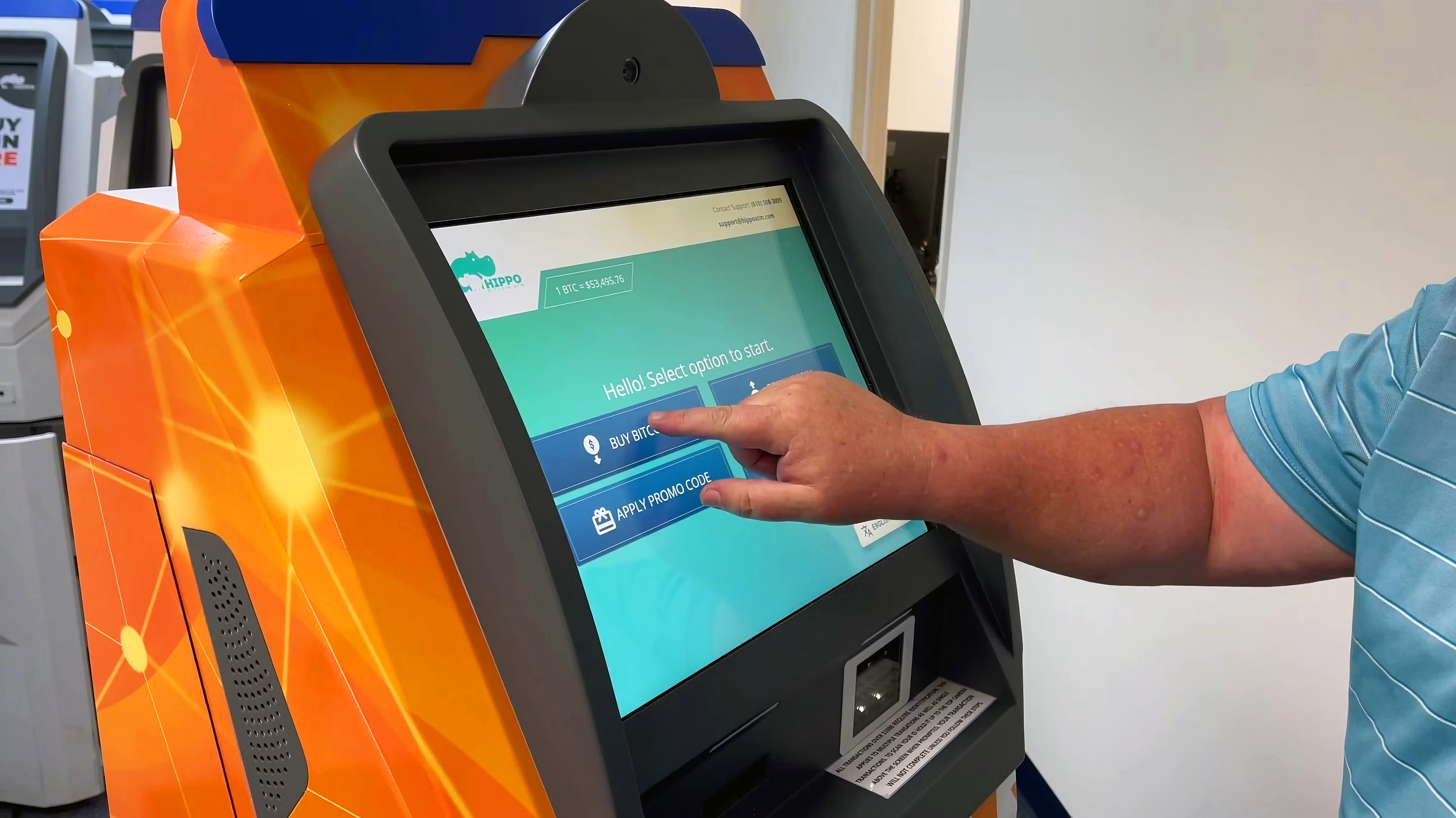
Kiosks are not anonymous, and anyone telling you otherwise is either out of date or selling something. Operators are registered money services businesses with anti-money-laundering obligations, and verification escalates with the amount.
Typical verification ladder (varies by operator)
- Under ~$250
- Mobile number plus SMS code; sometimes a camera capture
- $250 – $1,000
- Driver's licence or state ID scan, name and date of birth
- $1,000 – $3,000
- ID plus selfie match, occasionally SSN last four
- Above ~$3,000
- Enhanced review, proof of address, source-of-funds questions
- From 1 Jan 2027
- Statutory Florida caps: $2,000/day for customers under 7 days, $10,000/day thereafter
Operators also apply rolling limits — daily, weekly and monthly — that are separate from the per-transaction cap. Splitting a large purchase across several machines to stay under a threshold is called structuring, it is detectable, and it is a federal problem you do not want. If you need to move a larger amount, use an OTC desk or a bank transfer.
Florida's new kiosk law changes the deal
This is the most consequential development for Orlando kiosk users in years. The Florida Virtual Currency Kiosk Act (CS/HB 505), passed by the Legislature in 2026, brings virtual currency kiosk businesses inside the definition of a money services business under Chapter 560 and requires registration with the Office of Financial Regulation. Most provisions take effect 1 January 2027, with the pre-operation registration requirement biting 1 March 2027; existing operators must file within 30 days of the effective date.
What it actually gives you as a customer: mandatory fraud warnings on the machine, a physical or electronic receipt itemising the transaction, the operator's contact details, a statement of liability and the refund policy — plus daily transaction caps and, crucially, a conditional full refund within 72 hours on your first-ever kiosk transaction if you report the fraud to the operator and to law enforcement or a government agency within 60 days and provide proof such as a police report or notarised affidavit.
Notice what the state did not do: it did not cap fees. Instead it made first-transaction scam losses the operator's cost of doing business, which pushes them to screen aggressively at the moment of highest risk. Given Florida logged around 1,213 kiosk-related fraud complaints in 2025 with roughly $32.8 million in adjusted losses across 3,100-plus machines statewide, that is a targeted response to a real problem.
From our field notes
The pattern we kept seeing while checking machines around Orlando was the same one Florida legislators were reacting to. On three separate occasions we watched someone at a kiosk on the phone, reading a QR code off the screen of that phone rather than from their own wallet. That is the shape of nearly every kiosk scam: a stranger on a call supplies the destination address. If anyone — the "IRS", "Amazon security", a "police officer", a romantic interest, a tech-support agent — is on the phone while you are at a machine, the transaction is a scam. There is no exception to this rule.
Using a kiosk safely, step by step
Install a wallet before you leave the house
Set up a non-custodial mobile wallet at home, write the recovery phrase on paper, and have the receive QR code ready. Never let a machine or a person generate a destination address for you.
Check the operator, then check the rate
Read the operator name on the machine and its published fee page. Start a transaction, read the quoted rate, and compare against live spot on your phone before inserting a single bill.
Verify to the tier you need, no higher
Enter your number, confirm the code, scan your licence if the amount requires it. If a machine asks for something that feels excessive for the amount, stop.
Scan your own wallet's QR code
Only your own. Hold the phone steady; a mis-scanned address means coins gone permanently with no recourse from anyone.
Insert cash and read the confirmation screen
Check the dollar amount and the crypto amount before confirming. Most machines will not accept partial refunds once the cash is in.
Keep the receipt and wait for confirmation
Take the printed receipt, and stay put until you see the incoming transaction in your wallet. If it does not appear within twenty minutes, call the operator's support number from the receipt.
Same crypto, a fraction of the fee
If you have a bank account or a debit card, there is very little reason to pay kiosk pricing. CEX.IO is a FinCEN-registered money services business with state money transmitter licences and supports cards, bank transfers, Apple Pay and Google Pay.
CEX.IO is a FinCEN-registered Money Services Business holding money transmitter licences in multiple US states. Availability of products and payment methods depends on your state of residence and verification level. Crypto is volatile — never risk money you need.
Cheaper alternatives, ranked
If your reason for using a kiosk is habit rather than necessity, three routes beat it comfortably. First, deposit your cash at your own bank branch or a supported retail counter, then fund an exchange by ACH — that turns a 14% cost into something closer to half a percent, at the price of a day or two of waiting. Second, a retail cash-in network such as Coinme typically prices several points below standalone kiosks. Third, if you have a debit card at all, a card purchase on a regulated exchange lands around 3%–4% and is instant.
The only scenario where a kiosk genuinely wins is when you have cash, no bank relationship, no card, and a same-hour deadline. That is a narrow window, and it is worth knowing you are inside it before you pay for it.
- Buying Bitcoin with cash in Orlando — every cash-in route compared.
- Neighborhood guide — area-by-area machine coverage and practical notes.
- Selling Bitcoin for cash — two-way machines and better alternatives.
- Florida crypto rules — the full text of what CS/HB 505 changes.
- Kiosk scams and red flags — how the phone-call scam actually works.
Frequently asked questions
How many Bitcoin ATMs are there in Orlando?
Aggregators tracking the market list roughly 140 virtual currency kiosks inside Orlando city limits, operated by about 18 different companies. Counting the wider metro — Kissimmee, Sanford, Winter Garden, Apopka, St. Cloud — pushes the figure well past 200. The number moves constantly as operators redeploy machines between host stores, so treat any count as a snapshot rather than a fixed fact.
What does a Bitcoin ATM in Orlando actually charge?
Expect 10%–23% all in. CoinFlip publishes a range of about 4.99% to 21.9% depending on machine, coin and direction, plus a network fee of roughly $2.49–$2.99. Bitcoin Depot's economics are similar. The percentage is applied as a markup on the exchange rate rather than an itemised line, which is why so many first-timers do not notice until they compare the coin received to the spot price.
Do Orlando Bitcoin ATMs require ID?
It scales with amount. Under a few hundred dollars, most machines want only a mobile number plus an SMS code and sometimes a selfie. Above that, expect a driver's licence scan, and at the top tiers proof of address or a short questionnaire about the source of funds. From 1 January 2027, Florida's new kiosk statute imposes daily caps of $2,000 for customers who have been enrolled less than seven days and $10,000 for everyone else.
Can I sell Bitcoin for cash at an Orlando kiosk?
At some, not all. Two-way machines are a minority of the Orlando fleet and are concentrated in higher-traffic retail locations. The flow usually involves initiating a sale in the operator's app, sending the coin, then entering a redemption code at the machine to dispense bills. Sell-side markups are typically a little lower than buy-side but still substantial. See selling Bitcoin in Orlando.
Are Bitcoin ATMs in Florida legal and regulated?
Legal, yes. Regulated — increasingly. Operators handling virtual currency for Floridians fall under the money services business framework in Chapter 560, Florida Statutes, and the 2026 Virtual Currency Kiosk Act (CS/HB 505) folds kiosk businesses into that framework explicitly, adding fraud warnings, itemised receipts, daily limits and a conditional 72-hour refund on a customer's first transaction. Registration duties bite from early 2027. Details on our Florida rules page.
Is there a cheaper way to buy Bitcoin with cash in Orlando?
Yes, several. Retail cash-in networks such as Coinme generally undercut standalone kiosks, and depositing cash at your own bank branch then funding an exchange by ACH is dramatically cheaper if you can wait a day or two. We compare all of them on buying Bitcoin with cash in Orlando.