Spending · Metro Orlando
Crypto Debit Cards in Orlando
The practical way to spend digital assets at a Wawa on Colonial, a coffee shop by Lake Eola or a hotel on I-Drive. Crypto cards convert at the point of sale so the merchant only ever sees dollars — which is elegant, occasionally expensive, and creates a taxable event with every single tap.
Licensed exchange · card, bank, Apple Pay and Google Pay
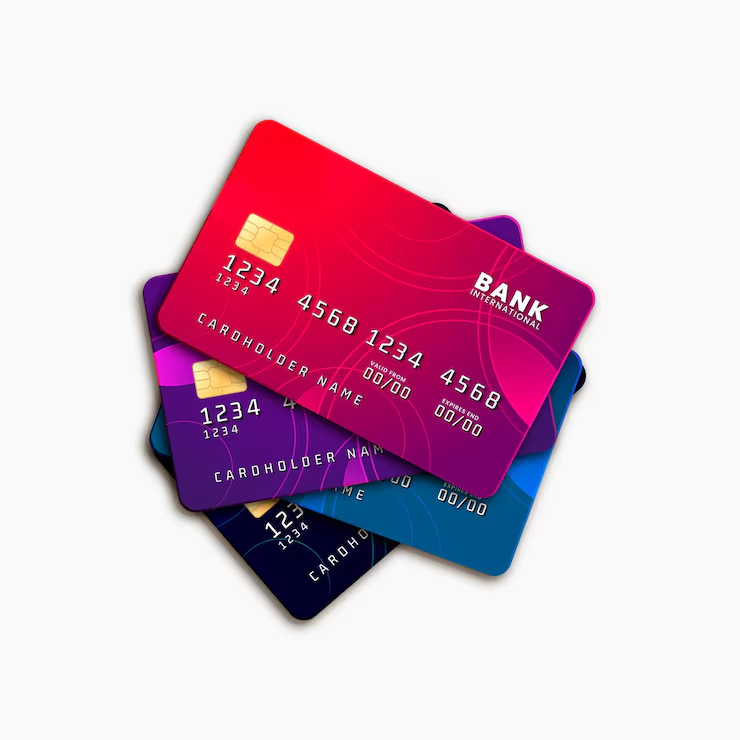
Almost nowhere in Orlando accepts Bitcoin directly. That sounds like a problem for spending crypto and it mostly is not, because crypto debit cards solved the acceptance question by sidestepping it entirely — they turn crypto into dollars in the moment of the transaction, on the existing Visa and Mastercard rails.
The merchant sees a card payment. Your account sees a crypto sale. Both are true simultaneously, which is clever engineering and has a consequence people rarely think through until April.
What happens in the two seconds after you tap
You present the card. The terminal authorises against a dollar amount as it would for any card. The card issuer, seeing an authorisation request, sells the crypto you designated as the funding asset at the prevailing rate, converts to dollars, and settles the transaction. The merchant is paid in dollars and never touches crypto.
Three costs can attach to that sequence. There is the conversion spread, which is how issuers usually make their money and which is often not itemised. There may be a card or account fee, monthly or per-transaction depending on the product. And if you spend outside the US there is typically a foreign transaction charge, though that is irrelevant for most Orlando spending.
Where crypto card costs hide
- Conversion spread
- Usually 0.5%–2%, applied at the moment of sale and rarely itemised
- Monthly or annual fee
- Waived on some tiers, charged on others
- ATM withdrawals
- Free up to a monthly cap, then a percentage or flat fee
- Reward tiers
- Best rates typically require staking the issuer's own token
- Tax friction
- Not a fee, but every spend is a reportable disposal
The tax reality nobody mentions in the marketing
This is the most important section on the page. The IRS treats cryptocurrency as property, and spending property is disposing of it. So every time you tap a crypto card, you have sold crypto — and you have realised a capital gain or loss equal to the difference between your cost basis and the value at the moment of the transaction.
Buy a $6.50 coffee with Bitcoin you acquired at a much lower price and you have a small taxable gain. It might be forty cents. It is still, technically, a line item on Form 8949. Do that daily for a year and you have created several hundred micro-disposals, each with its own date, basis and proceeds.
Florida residents catch a real break here: no state income tax means no state-level capital gains reporting on any of it. The federal obligation stands regardless, and there is no de minimis exemption for small crypto transactions in current US law.
If you use a crypto card for everyday spending, use portfolio software that imports card transactions automatically. Reconstructing four hundred small disposals by hand in April is genuinely awful and it is the single most common reason Orlando filers end up paying a specialist. Alternatively — and this is what we do — fund the card with a stablecoin. A dollar-pegged asset produces near-zero gain or loss on each spend, which makes the tax reporting trivial while keeping the convenience. More on our tax page.
Where these cards work in Metro Orlando
Everywhere. That is the whole point and it is worth stating plainly, because people expect a caveat. A Visa or Mastercard-branded crypto card works at Publix, Wawa, RaceTrac, Target, the theme parks, downtown restaurants, Orlando International Airport, hotels, Uber, and every online merchant that takes cards. Merchant acceptance of crypto is irrelevant because no crypto reaches the merchant.
Where you will hit friction is the same places any debit card hits friction: car rental holds, hotel incidental authorisations and petrol pump pre-authorisations, all of which place a temporary hold larger than the final charge. With a crypto card that hold locks up the underlying asset for the duration. Not a problem, just something to know before you rent a car at MCO with a card funded by a volatile asset.
| Crypto debit card | Sell then withdraw | Direct crypto payment | |
|---|---|---|---|
| Merchant acceptance | Universal | Universal (dollars) | Very limited in Orlando |
| Speed | Instant | 1–3 days | Minutes |
| Cost | 0.5%–2% spread | 0.1%–0.5% + withdrawal | Network fee only |
| Tax records | Many small disposals | One clean disposal | One per payment |
| Best for | Everyday spending | Large purchases | Willing merchants only |
The rewards question
Crypto cards compete on cashback, and the headline numbers can look extraordinary next to a traditional rewards card. Read the structure before believing the rate.
On most programmes the top tiers require staking a substantial amount of the issuer's own token for a fixed period. That is not a fee — it is a leveraged bet on a volatile asset, taken in order to earn a percentage on your grocery spending. If the token halves, the rewards you earned will not come close to covering it. The base tier, requiring no stake, is the honest number to plan around.
Rewards terms have also been revised downward across the industry more than once. Building a household budget around a specific crypto card cashback rate is building on sand. Take the base rate, treat any bonus as temporary, and never lock up capital you would not otherwise hold.
You need crypto before you can spend it
Start on a licensed exchange with published US registration, then fund a card from there. CEX.IO supports cards, bank transfers, Apple Pay and Google Pay in one verified account.
CEX.IO is a FinCEN-registered Money Services Business holding money transmitter licences in multiple US states. Availability of products and payment methods depends on your state of residence and verification level. Crypto is volatile — never risk money you need.
Choosing one, practically
Four questions, in order of importance. Does the issuer serve Florida residents and support your state — availability genuinely varies and changes. What is the conversion spread at the base tier, with no token staked. Which assets can fund the card, and can you fund it with a stablecoin for tax simplicity. And what happens if the issuer freezes your account — where does your money sit, and is the custodian identifiable and regulated.
That last question matters more than the cashback rate and almost nobody asks it. A crypto card is a custodial product: the issuer holds the assets that fund it. Keep only spending money there, the same way you would not keep your savings in your physical wallet. Long-term holdings belong in self-custody.
How we actually use these
Our own approach after two years of testing: fund the card with a stablecoin, keep roughly a month of discretionary spending on it, and never let appreciated Bitcoin near a card. It gives you the convenience without turning every sandwich into a capital gains calculation, and it removes the temptation to spend an asset you were holding for the long term because it happens to be sitting on a card in your pocket. The tax simplification alone is worth the small opportunity cost.
What about merchants that take crypto directly?
A small number in Orlando do, mostly independent businesses, some professional services, and a handful of online operations run from Central Florida. Paying directly avoids the card issuer's spread and costs only the network fee, which is attractive for larger amounts. It is still a disposal for tax purposes.
The list is short and it changes, which is why we maintain it separately on who accepts crypto in Orlando. For everyday use, a card remains far more practical.
Bottom line
Crypto debit cards are the most useful piece of infrastructure for anyone who wants their digital assets to do something other than sit still. They work everywhere in Orlando, the conversion is invisible, and the fees are reasonable at the base tier. Fund with a stablecoin, ignore the token-staking reward tiers, keep only spending money on the card, and accept that every purchase is technically a taxable disposal. Do that and it is a genuinely good product.
- Who accepts crypto in Orlando — direct payment options locally.
- Crypto taxes — handling many small disposals sanely.
- Selling and cashing out — the better route for large amounts.
- Wallets and custody — why card balances are not savings.
- Best exchanges — where to acquire the assets first.
Frequently asked questions
How does a crypto debit card work at a Publix checkout?
Invisibly, from the merchant's side. You tap or swipe a normal Visa or Mastercard. Behind the scenes the issuer sells the crypto you designated, converts it to dollars at that moment and settles the transaction in dollars. Publix receives dollars and has no idea crypto was involved.
Do I pay tax every time I spend crypto in Orlando?
Yes, at federal level. Each spend is a disposal of property, so you realise a capital gain or loss on the difference between what the crypto cost you and what it was worth at the moment of the transaction. Buying a $6 coffee with appreciated Bitcoin creates a small taxable event that technically belongs on Form 8949. Florida charges no state income tax, so there is no state layer.
Are crypto card rewards worth it?
Sometimes, with caution. Headline rates look attractive but the best tiers usually require locking up a large amount of the issuer's own token, which is itself a volatile bet. Rewards terms have also been revised downward repeatedly across the industry. Treat the base rate as the real rate and any token-tier bonus as temporary.
Can I use a crypto card at a Bitcoin ATM or to get cash?
Most crypto cards support ATM withdrawals up to a monthly limit, often with fees above that. Regular bank ATMs, not crypto kiosks — kiosks are cash-in and cash-out devices for crypto, not card terminals. Withdrawal limits are usually low enough that this is a convenience feature rather than a cash-management strategy.
Which crypto card works best in Central Florida?
Any Visa or Mastercard-branded card works everywhere those networks are accepted, which is essentially all of Metro Orlando. The differentiators are fees, rewards structure, supported assets and whether the issuer serves Florida residents. Availability by state changes, so verify during signup.
Is a crypto card better than just selling crypto for dollars?
For small everyday spending, yes — it saves you the sell-and-withdraw cycle. For anything large, selling deliberately on an exchange and withdrawing dollars gives you better pricing and a much cleaner record. See selling and cashing out.