Cashing out · Orlando & Central Florida
How to Sell Bitcoin and Cash Out in Orlando
Buying gets all the attention. Selling is where the real friction lives — withdrawal holds, wire cut-offs, kiosk ceilings and a tax event you probably have not thought about. Here is every route from crypto back to dollars in Orange County, with the costs and the delays stated up front.
Sell, then withdraw by ACH or wire to your Florida bank
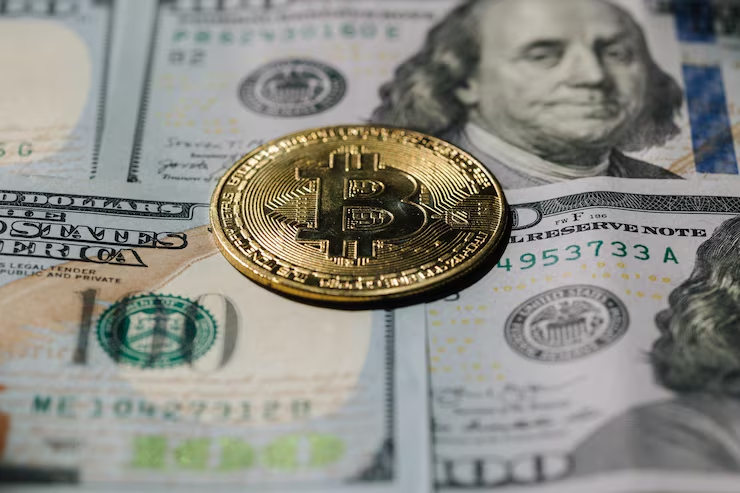
Almost every guide to crypto in Florida stops at the purchase. That is a strange place to stop, because the exit is the part with the deadlines attached — you are usually selling because you need the money for something, and discovering a five-day withdrawal hold at that moment is unpleasant.
There are four ways out in Orlando, and they trade off against each other exactly the way the entry routes do: cheapest is slowest, fastest is most expensive, and the sweet spot depends on the size of the position.
| Route | Typical cost | Time to spendable dollars | Practical ceiling |
|---|---|---|---|
| Exchange sale + ACH withdrawal | 0.2%–1.5% | 1–3 business days | $25k–$100k/day |
| Exchange sale + domestic wire | 0.2%–1.5% + $10–$25 | Same or next day | High |
| Two-way Bitcoin ATM | 7%–15% | 15–40 minutes | ~$1k–$5k per visit |
| OTC desk | 0.3%–1% spread | Same day by appointment | Very high |
Route one: sell on an exchange, withdraw to your bank
This is the default and for most people the right answer. You sell into US dollars on the platform, then move those dollars to your bank. The selling part is cheap — fractions of a percent on an order book, a percent or two on a simple-mode screen. The withdrawal part is where Orlando-specific detail matters.
ACH withdrawals are free or nearly free on most major platforms and clear into local banks and credit unions in one to three business days. Wires cost a flat fee, typically $10 to $25 on the exchange side plus whatever your bank charges to receive, and land same-day if you beat the cut-off — usually mid-afternoon Eastern. If you bank with one of the large national institutions the process is uneventful. Smaller Central Florida credit unions occasionally flag inbound crypto-exchange transfers for manual review; a phone call to your branch before you initiate a first large withdrawal saves a lot of anxiety.
Nearly every platform applies a hold on your first fiat withdrawal, and a separate hold if you funded by ACH within the previous few days. Neither is negotiable. If you know you need money by a certain date, start the sale and the withdrawal at least a week earlier. This one habit eliminates the most common complaint we hear from readers.
Route two: two-way Bitcoin ATMs for same-day cash
If you need physical bills today and cannot wait for a bank transfer, a two-way kiosk is the only route that delivers. Orlando has them, though they are a minority of the roughly 140 machines in the city — concentrated in higher-traffic retail on the Colonial Drive and South Orange Blossom Trail corridors, and among CoinFlip's fleet more often than Bitcoin Depot's.
The flow is not intuitive the first time. You initiate the sale in the operator's app or at the machine, send Bitcoin from your wallet to an address the operator supplies, wait for on-chain confirmations, then return to the machine and enter a redemption code to dispense cash. The wait between sending and collecting can be twenty minutes or more depending on network conditions, and the machine has a finite amount of cash in it — larger redemptions sometimes come out in stages.
Sell-side markups are lower than buy-side but still substantial, generally high single digits to low teens once you account for the rate spread. Per-visit ceilings of a few thousand dollars are normal. Our kiosk guide covers which operators run two-way machines locally.

Route three: an OTC desk for size
Once you are selling more than roughly $25,000 of a single asset, retail interfaces start working against you. A large market order eats through the visible order book and your average fill price drifts. An over-the-counter desk solves that by quoting a single price for the entire block and settling by wire.
Central Florida has no shopfront you can walk into, but several brokers serve the region by appointment, and some kiosk operators — CoinFlip among them — run OTC arms specifically for larger tickets. Expect real onboarding: identity documents, source-of-funds evidence, sometimes an accountant's letter. That is normal and a good sign. Full detail on OTC trading in Orlando.
Route four: peer-to-peer, and why we are cautious
You can sell directly to another person, and platforms exist to escrow those trades. In a city with an active meetup scene it happens. We include it for completeness rather than as a recommendation.
The problems are practical. Meeting a stranger to hand over several thousand dollars in cash carries obvious physical risk. Counterfeit bills are a genuine issue at the amounts people trade in person. And a chargeback-capable payment method on the other side of a P2P trade — Zelle reversals, PayPal claims — creates a scenario where you have sent irreversible crypto and received reversible money. If you do it anyway, use a platform with escrow, meet inside a bank lobby during business hours, and never accept a payment method that can be clawed back.
Selling is easier on a platform you already trust
CEX.IO supports selling to US dollars with bank withdrawal, and its US licensing is published for anyone to verify. Setting the account up before you need to sell removes the verification delay from the critical path.
CEX.IO is a FinCEN-registered Money Services Business holding money transmitter licences in multiple US states. Availability of products and payment methods depends on your state of residence and verification level. Crypto is volatile — never risk money you need.
The tax event you just created
Selling crypto is a disposal, and a disposal is a taxable event at federal level whether you move dollars to your bank or not. Swapping Bitcoin for a stablecoin is a disposal. Spending crypto at a merchant is a disposal. Only moving coin between wallets you own is not.
Florida residents get a real advantage here — there is no state income tax and therefore no state-level capital gains tax on the profit. That is not a loophole, it is just how Florida works, and it is a genuine reason people relocate here. But the federal treatment is identical to anywhere else: gain or loss equals proceeds minus cost basis, short-term if held a year or less and taxed at your ordinary rate, long-term otherwise and taxed at preferential rates.
Two practical notes. First, if you have held for eleven months, the difference between selling now and selling in five weeks can be several percentage points of tax — worth checking before you click. Second, harvest your losses; realised losses offset realised gains and up to $3,000 of ordinary income per year. Our Orlando tax page goes deeper, including how to find a Central Florida CPA who genuinely handles digital assets rather than one who says they do.
What we have learned from reader questions
The most common cash-out mistake has nothing to do with fees. It is people selling at a kiosk because they did not know their exchange withdrawal would have cleared in two days, and paying eleven percent for a delay they could have absorbed. When a reader writes to ask how to get cash out fast, our first question back is always the same: when do you actually need it? About half the time the answer is "end of the month", and the cheap route was available all along.
Withdrawal limits at a glance
Limits vary by platform and verification tier, but the shape is consistent. Fully verified accounts on major exchanges support fiat withdrawals in the tens of thousands per day. Kiosks are the constraint — per-transaction and daily caps are low by design, and from 1 January 2027 Florida's Virtual Currency Kiosk Act formalises daily ceilings of $2,000 for customers enrolled less than seven days and $10,000 thereafter. If your cash-out plan involves repeated kiosk visits to get under a limit, stop: that is structuring, it is detectable, and it is a federal offence regardless of intent.
- Crypto taxes for Orlando filers — what to do with the gain you just realised.
- OTC desks in Central Florida — for positions above $25,000.
- Two-way Bitcoin ATMs — which Orlando machines pay out cash.
- Bank transfer mechanics — the same rails, in reverse.
- Crypto debit cards — spending without a formal cash-out.
Frequently asked questions
How do I sell Bitcoin and get dollars into my Orlando bank account?
Sell on the exchange where you hold the coin, then withdraw dollars by ACH or wire to your bank. ACH is free or near-free and lands in one to three business days at most Central Florida banks and credit unions. A domestic wire costs $10–$25 and usually arrives the same business day if you initiate before the cut-off. Expect a short hold on your first fiat withdrawal from any platform.
Can I sell Bitcoin for cash in Orlando the same day?
Yes, at a two-way kiosk. You start the sale in the operator's app, send the coin, wait for confirmations, then enter a redemption code at the machine to dispense bills. Two-way machines are a minority of Orlando's fleet, and sell-side markups still run high single digits to low teens. Per-transaction cash-out ceilings are common, often a few thousand dollars.
Do I pay Florida tax when I sell Bitcoin?
No state income tax — Florida does not levy one, so there is no state capital gains tax on your crypto profit. Federal tax absolutely applies. Each sale is a disposal of property reported on Form 8949, with short-term gains taxed as ordinary income and long-term gains at preferential rates if you held for more than a year. See crypto taxes in Orlando.
What is the cheapest way to cash out a large amount?
Above roughly $25,000, an OTC desk usually beats a retail exchange because you get a single quoted price for the whole block instead of walking down the order book. Below that, a limit order on an exchange with maker pricing plus an ACH withdrawal is hard to beat. Never cash out a large position through kiosks — the limits force you into many transactions and the cost is punitive.
Why is my fiat withdrawal on hold?
Usually one of three reasons: it is your first withdrawal and the platform applies a standard cooling-off period; you deposited by ACH recently and the platform is waiting out reversal risk; or the amount triggered a compliance review. Responding quickly to any document request is the fastest route through. Planning ahead — selling a few days before you actually need the money — removes most of the stress.
Should I sell everything at once?
We do not give investment advice and will not tell you when to sell. What we will say mechanically: large market orders on thin books get worse prices, and splitting a sale into tranches or using limit orders generally executes better. That is an execution observation, not a market call.