Payment methods · Prepaid
Prepaid Cards and Crypto: The Honest Answer
Most guides on this topic are written to sell you something. Here is the plain version: prepaid cards work rarely, cost more when they do, and the closely related gift card question is not a payment method at all — it is the most common fraud script in America. This page covers all three, plus what to use instead.
Cards, bank transfer, Apple Pay and Google Pay all supported
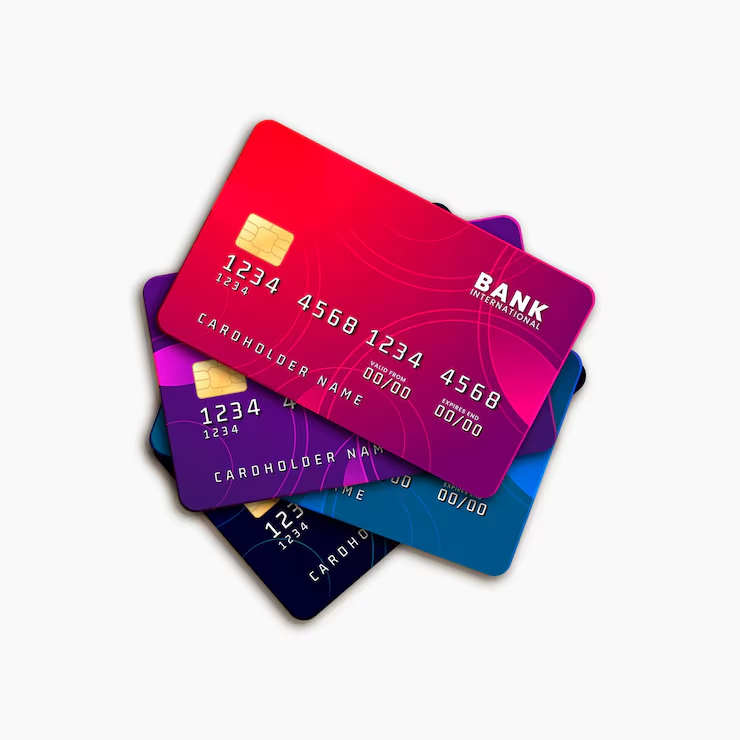
People ask about prepaid cards for one of two reasons. Either they do not have a bank account and are looking for any route in, or they were handed a prepaid card as a gift and want to turn it into something they find more interesting. Both are reasonable. Neither is well served by prepaid cards.
We will explain why the technology fights you here, and then spend the rest of the page on the alternatives — because for the unbanked reader in particular there are better answers, and nobody seems to write them down.
Why the decline happens
A crypto exchange running a card transaction checks several things at once, and prepaid products fail most of them by design.
Address verification. The processor compares the billing address you enter against the address on file with the card issuer. A gift card bought off a rack at a Publix has no address on file, so there is nothing to match and the check fails.
Name matching. Regulated platforms require that the payment instrument belong to the verified account holder. An unregistered prepaid card has no cardholder name, which makes that requirement impossible to satisfy.
BIN blocking. The first six to eight digits of a card identify the issuer and product type. Many exchanges maintain blocklists covering prepaid ranges outright, because anonymous funding is precisely what anti-money-laundering programmes are built to prevent.
Chargeback exposure. Prepaid cards carry weaker protections and higher fraud rates, so processors price and restrict them accordingly.
| Product | Registered in your name? | Likely outcome |
|---|---|---|
| Reloadable prepaid, fully registered | Yes, with address | Occasionally works on platforms that allow prepaid BINs |
| Payroll or government benefit card | Yes | Sometimes works; check the issuer's terms first |
| Non-reloadable Visa or Mastercard gift card | No | Declined nearly always |
| Retailer gift card (Apple, Google Play, Amazon) | No | Impossible — and a scam if requested |
| Virtual card from a bank app | Yes, tied to your account | Usually works — this is a debit card, not prepaid |
That last row is genuinely useful and often overlooked. A virtual card number generated by your own bank or card app is not a prepaid card — it is your normal account with a disposable number. Those work fine and give you the privacy benefit people are often actually after.
You are being defrauded. This is not a payment method that occasionally has problems — it is the mechanism behind an enormous share of consumer fraud losses in the United States, and Florida is among the most heavily targeted states. Nobody legitimate — not the IRS, not a utility, not a police officer, not Amazon, not a crypto exchange, not a romantic partner, not a "government grant" administrator — will ever ask you to buy retail gift cards and read the codes over the phone. Hang up. Keep the cards and the receipts, and report it. Our Orlando scams page has the local reporting routes.
If a prepaid card is genuinely all you have
Some readers are working with exactly one instrument and no bank relationship. Here is the honest sequence to try.
Register the card properly
Go to the issuer's website on the back of the card and register your name and address. This alone converts many automatic declines into approvals, because address verification now has something to check.
Confirm the card allows this category
Read the cardholder agreement. Many prepaid products explicitly prohibit cryptocurrency, gambling and money transfer categories, and no amount of retrying changes a contractual block.
Match names exactly
The name on the registered card must match your verified exchange profile character for character.
Test with a small amount
Try $20 before $200. A decline on the small amount tells you the route is closed without tying up your balance.
If it fails twice, stop
Repeated declines can flag your exchange account for review. Switch to one of the routes below instead.
Use a rail that is designed to work
CEX.IO supports Visa and Mastercard debit, bank transfers, Apple Pay and Google Pay — four routes with predictable approval rather than one with a coin-flip outcome.
CEX.IO is a FinCEN-registered Money Services Business holding money transmitter licences in multiple US states. Availability of products and payment methods depends on your state of residence and verification level. Crypto is volatile — never risk money you need.
Better options for unbanked Orlando buyers
This is the part of the page that matters most, because the prepaid question is usually a symptom of not having a bank account rather than a preference for prepaid cards.
Retail cash-in networks. Services such as Coinme let you pay cash at a participating counter and receive crypto in an app. Effective cost lands well below kiosk pricing, and no bank account is required — only identity verification in the app.
Bitcoin ATMs. Expensive at 10% to 23%, but reliable and everywhere in Orlando. If you need crypto today with cash in hand, this works. Our kiosk guide explains how to avoid the worst-priced machines, which in this metro are concentrated in the tourist corridor.
Open a basic account. Worth saying because it is the answer people least expect from a crypto site. Several Central Florida credit unions offer low- or no-minimum checking accounts with modest documentation requirements, and a debit card from one of them converts a 14% kiosk purchase into a 3% card purchase or a sub-1% ACH purchase. The one-time hassle of opening an account pays for itself on the second transaction.
What the prepaid question usually really is
When a reader asks us how to buy Bitcoin with a prepaid card, the follow-up question is almost always revealing. Roughly half the time they have no bank account and prepaid is their only card. The other half of the time somebody told them to do it — and that second group is the one we worry about, because "buy a prepaid card and send me the code" is a fraud script, not a purchase method. If you arrived at this page because of instructions from someone else, that is the most important sentence here.
The privacy misconception
A common assumption is that prepaid cards offer anonymity in crypto purchases. They do not, for a straightforward reason: the exchange already knows who you are. You completed full identity verification to open the account, and no funding instrument changes that. Regulated platforms in the United States are required to know their customers regardless of how the dollars arrive.
If your goal is simply not to hand your primary card number to a website, the better tools are a bank-issued virtual card number, Apple Pay or Google Pay. All three keep your real card details away from the merchant while still passing verification cleanly.
Bottom line
Prepaid cards are the worst-supported funding method in crypto and the effort-to-success ratio is poor. Register the card and try a small amount if it is truly your only option, but expect to fail. Then use a retail cash-in network, a kiosk if you must, or spend an hour opening a basic checking account and unlock every cheap route permanently. And if anyone asked you to buy gift cards for a crypto purchase, close this page and read our scams guide instead — that is the more urgent problem.
- Buying with cash in Orlando — every no-bank route ranked by cost.
- Debit and credit cards — what to use instead.
- Crypto debit cards — spending crypto rather than buying it.
- Scams and red flags — the gift card pattern in full.
- Bitcoin ATMs — reliable, cash-only, and how to avoid the worst pricing.
Frequently asked questions
Can I buy crypto with a prepaid Visa or Mastercard?
Sometimes, and the success rate is poor. Reloadable prepaid cards registered in your own name with a verified billing address occasionally work on exchanges that accept them. Non-reloadable gift cards bought off a rack almost never do, because they have no cardholder name or address for verification to match against.
Why do prepaid cards get declined at crypto exchanges?
Three reasons stack up. Address verification fails because the card has no registered address. The cardholder name does not match your verified exchange profile. And many exchanges deliberately block prepaid BIN ranges because untraceable funding is an anti-money-laundering problem. Any one of these is enough for an instant decline.
Can I use a gift card to buy Bitcoin?
Not through any legitimate route, and this deserves emphasis: requests to pay for crypto with retail gift cards are the single most common fraud script in the United States. If anyone asks you to buy gift cards and read the codes to them, you are being robbed. There is no exception, regardless of who they claim to be.
Are there better options if I have no bank account?
Yes, several and all of them beat prepaid. Retail cash-in networks like Coinme cost less and actually work. Bitcoin ATMs are expensive but reliable. And opening a basic checking account at a Central Florida credit union unlocks the cheapest route of all — see cash options.
Do Bitcoin ATMs accept prepaid cards?
Almost none. Virtually every kiosk in Orlando is cash-only by design — the hardware is built around a bill validator, not a card reader. A machine advertising card acceptance is unusual enough that we would want to check the operator carefully first.
What about crypto-specific reloadable cards?
Different product entirely. Crypto debit cards let you spend crypto you already own at ordinary merchants, rather than funding a purchase. Those work well and are covered on our crypto debit card page.